
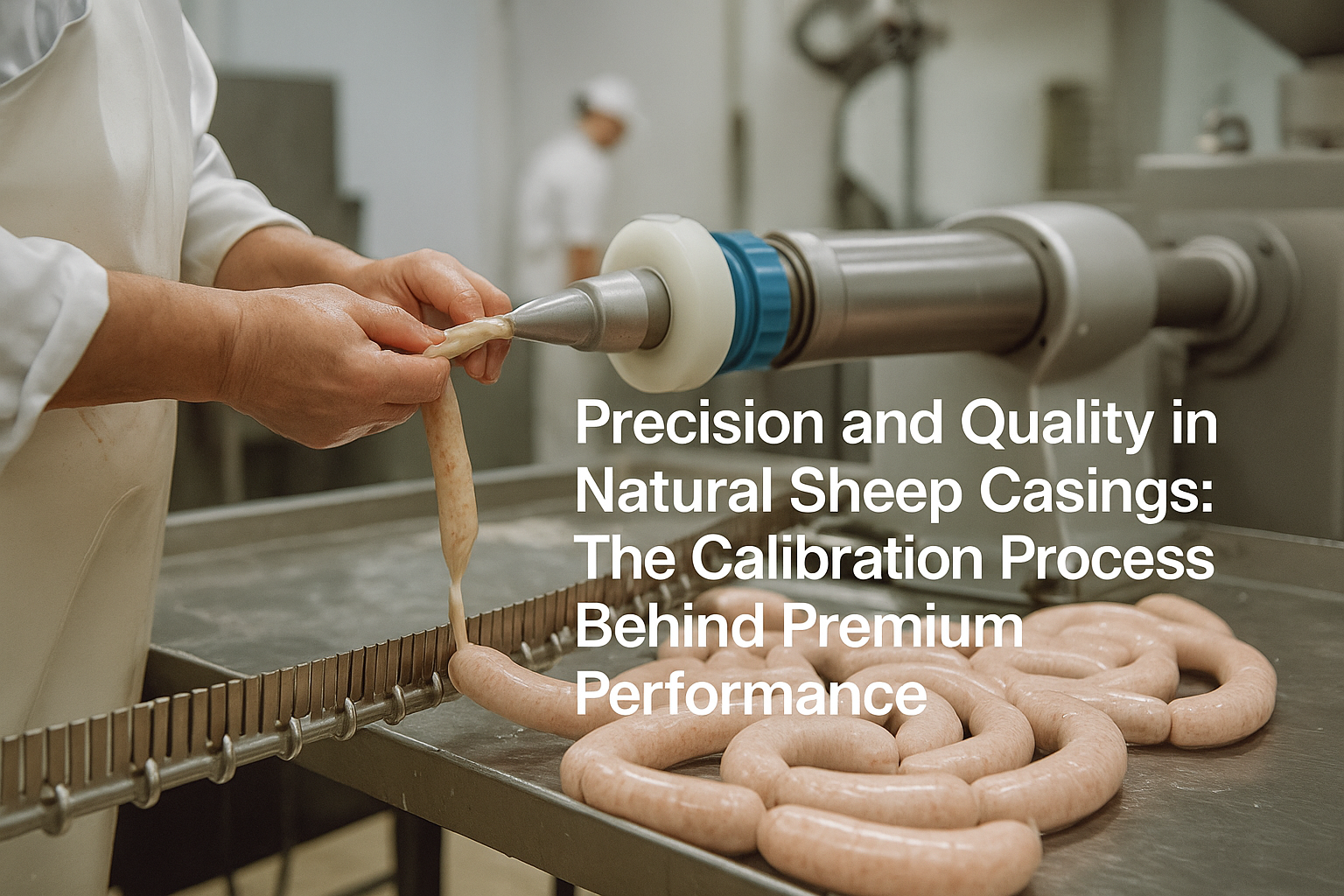
Precision and Quality in Natural Sheep Casings: The Calibration Process Behind Premium Performance
Precision and Quality in Natural Sheep Casings: The Calibration Process Behind Premium Performance
Natural sheep casings are at the heart of premium sausage production. Their performance determines not only how a sausage looks and feels, but also how it tastes and behaves during cooking. In an industry where precision defines quality, the calibration process of natural casings plays a crucial role in ensuring reliability, consistency, and efficiency for professional manufacturers.
At Hang Vala, quality begins long before the sausage is made. It starts with the careful selection, cleaning, and calibration of every meter of casing to meet the exact standards demanded by top-tier producers. Each step—from sourcing to packaging—is designed to deliver a product that performs with uniformity, strength, and safety.
Understanding the Calibration Process
Calibration refers to sorting and measuring natural sheep casings according to their diameter and length. This process allows manufacturers to choose casings that perfectly match the intended sausage size, ensuring uniform filling, weight control, and visual consistency across production lines.
Sheep casings are typically graded into precise size ranges such as 20/22 mm, 22/24 mm, 24/26 mm, and so on. These measurements represent the average internal diameter of the casing when filled. Even a one-millimeter variation can affect how the sausage fills, cooks, and appears—making calibration an essential stage in quality control.
How calibration works
-
Initial selection:
Raw casings are collected only from healthy, approved livestock and undergo veterinary inspection. -
Cleaning and desalting:
The casings are washed, defatted, and treated in food-grade brine solutions to remove impurities. -
Grading by diameter:
Specialized machines and skilled technicians measure each section using air or water pressure systems to determine its average internal size. -
Length sorting:
Casings are organized into standard bundles (called “hanks”), each with consistent usable length for easier handling. -
Final inspection:
Every batch is checked visually and mechanically for uniformity, elasticity, and strength before packaging.
The result is a calibrated casing that performs predictably in high-speed sausage production—saving time, reducing waste, and ensuring that every link looks and feels the same.
The Role of Quality Control
Calibration alone is not enough; precision must be verified at every stage. That’s why Hang Vala implements a strict multi-step quality assurance system to guarantee compliance with global standards.
1. Material Integrity
Each batch of raw sheep casings is sourced only from certified slaughterhouses that follow hygiene regulations (EU 853/2004, HACCP, and ISO 22000). Samples are tested for microbiological safety, ensuring no pathogens or residues remain.
2. Structural Strength
Casings are tested for bursting resistance and elasticity. Overly fragile material can rupture during filling, while stiff casings may not twist properly. Hang Vala’s internal testing simulates industrial stuffing conditions to ensure consistent behavior under pressure.
3. Visual and Tactile Consistency
Technicians inspect each hank by hand to confirm transparency, smooth texture, and uniform wall thickness. Only casings that pass all checkpoints are approved for export.
4. Traceability and Batch Coding
Every product line is fully traceable—from origin to shipment—allowing producers to meet international audit requirements with confidence.
Why Calibration Matters for Manufacturers
For premium producers, the smallest variation can translate into significant production challenges. Accurate calibration ensures:
-
Efficient machine performance – uniform diameters allow smoother operation on automatic filling and linking lines.
-
Precise portion control – sausages maintain consistent weight and size, reducing giveaway and optimizing packaging.
-
Enhanced presentation – visual uniformity improves consumer perception and shelf appeal.
-
Reduced waste – fewer bursts, less downtime, and higher yield per batch.
In short, calibration transforms natural variability into industrial precision—turning a traditional raw material into a modern performance component.
Combining Tradition with Technology
While natural casings have been used for hundreds of years, the modern calibration process brings scientific accuracy to an age-old craft. Advanced measurement tools, optical scanners, and computer-controlled grading systems now complement the expertise of skilled workers. This blend of tradition and innovation ensures that the product retains its authentic characteristics while meeting the speed and consistency demands of modern production lines.
At Hang Vala, traditional hand-inspection is still an irreplaceable part of the workflow. Machines provide precision; human expertise guarantees quality.
Cleanliness and Preservation
Clean processing is essential to maintain the integrity of natural sheep casings. After calibration, the casings are preserved in high-purity food-grade salt. This method naturally inhibits bacterial growth and extends shelf life without chemical additives.
Casings are stored in controlled environments with regulated humidity and temperature. Before shipping, samples from every lot are re-tested to verify microbiological safety and salt concentration, ensuring the casings reach the customer in perfect condition.
Packaging and Export Standards
To protect the delicate structure of natural casings, packaging plays a key role. Hang Vala uses airtight containers and vacuum-sealed pouches that prevent contamination while maintaining moisture balance. Each pack is labeled with:
-
Diameter range
-
Length
-
Lot number
-
Country of origin
-
Preservation date
This transparency makes import inspections and production planning simpler for clients worldwide.
All shipments comply with EU, Middle Eastern, and Asian food import regulations, supported by health certificates and detailed documentation.
Sustainability Through Quality
The calibration process also contributes to sustainability. By reducing waste, extending shelf life, and maximizing yield, producers minimize environmental impact. Natural sheep casings are biodegradable and fully utilized by-products of the meat industry—nothing is wasted. High-precision processing ensures every meter serves a purpose, reinforcing both ecological and economic responsibility.
Customer Confidence and Brand Value
For sausage producers, quality calibration means predictability. Each box of Hang Vala casings performs the same way—batch after batch, shipment after shipment. This reliability builds trust with production teams and, ultimately, with consumers who notice the difference in texture, flavor, and appearance.
A consistent product line allows manufacturers to maintain brand standards, control costs, and support export growth. In the premium segment, precision is profit.
Conclusion: Precision Defines Quality
The excellence of a sausage begins long before it reaches the grill—it starts with the casing. Calibration transforms natural sheep casings from a raw biological material into a high-performance ingredient. Through precise grading, strict quality control, and clean preservation, Hang Vala ensures every meter meets the demands of modern premium production.
For professionals who value consistency, tradition, and trust, calibrated natural sheep casings are not just a choice—they are the standard.
